Frame Rate, Shutter Speed and the 180-Degree Rule
Why 24, 25, 30 and 60fps exist, how shutter speed shapes motion, and why UK creators need 1/50 indoors - the 180-degree rule for 50Hz countries.
Frame rate, shutter speed and the 180-degree rule are one system, not three settings. Frame rate decides how many pictures you take each second, shutter speed decides how much motion blur each picture contains, and the 180-degree rule ties the two together so that blur looks the way audiences expect. Get the relationship right and footage looks intentional; break it by accident and everything feels subtly wrong in a way viewers cannot name.
There is also a specifically British complication. Most creator advice on this subject is written for 60Hz countries and quietly assumes American mains electricity. Follow it under UK lighting and you get rolling bands of flicker across your footage. The fix is one number, and it is covered below.
Why do 24, 25, 30 and 60fps all exist?
Each rate is a leftover from a different technical history, and each still has a job.
- 24fps is the cinema standard, settled in the late 1920s as roughly the slowest rate that kept optical soundtracks intelligible. A century of films has trained audiences to read its motion as cinematic, which is the only reason anyone still chooses it.
- 25fps is the European television rate, chosen because PAL broadcast systems were built around 50Hz mains electricity - exactly half the mains frequency. It remains the natural rate for UK shooters, and it is close enough to 24 that the look is indistinguishable in practice.
- 30fps is the American equivalent, born of 60Hz mains and NTSC television. It looks slightly more immediate and less filmic, which suits news, vlogs and screen-heavy content.
- 50 and 60fps double the sampling of motion. Sport, fast camera moves and screen recordings all benefit; ordinary talking heads do not. They are also the practical route to slow motion - footage shot at 50fps and played at 25 runs at exactly half speed.
The honest summary for a UK creator: deliver at 25fps by default, use 50fps when motion or slow motion demands it, and reach for 24 only when you specifically want the cinema association and know your delivery platform handles it cleanly.
What does shutter speed do to video?
In stills photography, shutter speed is an exposure control. In video it is primarily a motion control. Each frame is exposed for the shutter duration, and anything that moves during that window smears across the frame. That smear is motion blur, and the amount of it per frame is what separates fluid footage from stuttery footage.
A fast shutter - say 1/500 at 25fps - freezes each frame crisply, but the gaps between one frame's position and the next become visible as a harsh, strobing quality. A slow shutter - 1/25 at 25fps - smears each frame so much that detail dissolves whenever anything moves. Between those extremes sits a band where each frame carries just enough blur to bridge it smoothly into the next. Audiences have watched a hundred years of footage shot in that band, so anything outside it reads as a deliberate effect or a mistake.
What is the 180-degree rule?
The rule: expose each frame for half of the frame interval. In settings terms, set the shutter speed to double the frame rate - 1/50 at 25fps, 1/60 at 30fps, 1/100 at 50fps, 1/120 at 60fps.
The name comes from film cameras, which exposed each frame through a rotating disc shutter - a half-circle of metal spinning once per frame. A 180-degree opening exposed the film for exactly half of each rotation, and generations of cinema were shot that way. Digital cameras kept the maths and dropped the disc; cinema cameras still express shutter as an angle, where 180 degrees always means half the frame interval whatever the frame rate.
Breaking the rule is a legitimate tool when it is chosen. War films and action sequences use much narrower angles (faster shutters) for a jittery, hyper-real crispness; music videos sometimes go wider (slower shutters) for dreamlike smear. The problem is breaking it by accident - most commonly by letting a camera in auto mode pick 1/2000 on a bright day, which is why daylight footage from phones and action cameras so often has that faintly nervous, strobing look.
Why do UK shooters need 1/50, not 1/60?
UK mains electricity alternates at 50Hz, and most artificial light pulses at double the mains frequency - 100 times per second. Incandescent bulbs glowed straight through the dips, but LED and fluorescent sources follow them, brightening and dimming 100 times a second, far too fast for eyes to see and exactly slow enough for a camera to catch.
A shutter speed of 1/50 or 1/100 exposes each frame for a whole number of those pulses, so every frame collects the same amount of light and the footage is steady. A shutter of 1/60 - the number US-centric tutorials recommend - catches a fraction of a pulse that drifts from frame to frame, and the drift shows up as slow rolling bands of brightness crawling through the shot. The same mismatch is why American footage flickers at 1/50 under 60Hz mains.
This is the quietly UK-specific part of the whole system, and it makes the standard advice simple: indoors in Britain, shoot 25fps at 1/50, or 50fps at 1/100 - never 30 or 60fps at 1/60 under artificial light unless you have confirmed the specific fixtures are flicker-free. Cheap LED panels and older ceiling lights are the worst offenders; higher-end video lights drive their LEDs at high frequency precisely to sidestep this. Our colour temperature and CRI guide covers the other half of getting artificial light right, and the portable lighting kit guide flags which budget options behave.
When is a high frame rate actually worth it?
50 or 60fps earns its cost in three places. Fast motion - sport, pets, children, anything panning quickly - genuinely resolves better with double the samples. Screen recording and gameplay capture look dramatically smoother, because interface motion has no natural blur to bridge frames. And slow motion requires it: 50fps conformed to a 25fps timeline gives clean half-speed, 100fps gives quarter-speed, with the 180-degree rule applied at the shooting rate (1/100 and 1/200 respectively).
Everywhere else it mostly eats storage and light. Files double in size, cards fill twice as fast, and every doubling of frame rate takes a stop of light away from the sensor because the shutter must halve to keep the angle at 180 degrees. A talking-head video at 60fps also carries a soap-opera immediacy that works against content trying to feel considered - the same reason television drama is not shot at 50.
The test worth applying: will this footage be slowed down, or does it contain fast motion the viewer needs to track? If neither, the standard rate is the better and cheaper answer.
How do you set this up in practice?
Pick the delivery frame rate first
25fps for UK web content by default, 50fps for fast motion or planned slow motion, 24fps only for a deliberate cinema look. Set the camera and the edit timeline to match.
Set shutter to double the frame rate
1/50 at 25fps, 1/100 at 50fps. On cameras that offer shutter angle instead of speed, set 180 degrees and it tracks any frame rate automatically.
Control daylight with ND, not shutter
Outdoors the fixed 1/50 will overexpose. Close the aperture or fit a neutral density filter (a sunglasses-like filter that cuts light without changing colour) rather than raising the shutter - raising it is how footage goes strobey.
Lock the phone down if you film on one
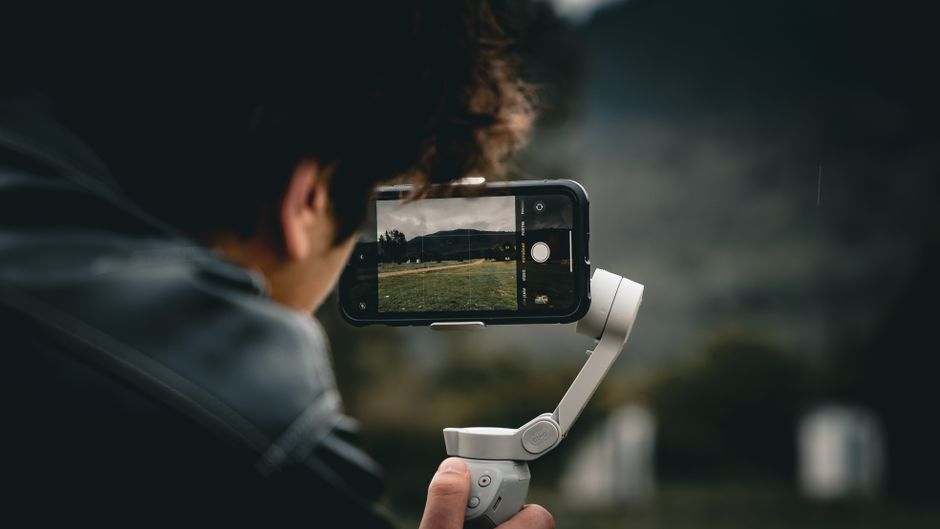
Phone cameras auto-pick shutter speeds and routinely break both the 180-degree rule and the mains-frequency match. A camera app with manual controls fixes both - relevant for anything shot on a phone rig.
Test under your actual lights
Record ten seconds under the room's lighting, play it back at full screen, and look for rolling bands. If they appear, the shutter and the mains frequency disagree - move to 1/50 or 1/100.
Frequently asked questions
Is 24fps or 25fps better for YouTube in the UK?
Why does my footage flicker indoors but not outside?
Can I break the 180-degree rule on purpose?
What shutter speed should I use at 60fps in the UK?
Do phones follow the 180-degree rule?
Colour Temperature, CRI and Mixed Lighting
Portable Lighting Kit for Reels
DJI Osmo Pocket 3 vs iPhone for Vlogging