What Is a Softbox? A Beginner's Guide to Soft Light
What a softbox is, why it makes light softer, the main shapes and mounts, and what matters when choosing one for YouTube and product video.
A softbox is the light modifier most new channels buy first, because it fixes the problem that makes home video look cheap: one small, bright bulb throwing hard shadows across a face or a desk. The box spreads that bulb's output across a much larger white panel, and a larger source makes softer light.
This guide explains what a softbox does and why it works, the parts every listing mentions, the main shapes and sizes, how the budget screw-in bulb kits differ from studio softboxes, and what matters when choosing one. It names no products and picks no winner: it is the background that makes any softbox listing readable. Where a term matters, it is explained before it is used.
The budget kits themselves are compared, with a final choice, in the budget softbox lighting kit post, part of the series on the kit a new YouTube channel needs.
What is a softbox?
A softbox is a light modifier: something that changes the shape and quality of light from a lamp rather than producing light itself. It is a fabric enclosure, held open by metal rods or ribs, that fits around a light source. The inside is lined with a silver or white reflective material, and the open front is covered by one or two layers of white diffusion fabric. Camera accessory maker SmallRig describes it simply as a controlled light diffuser that turns a small, harsh source into a large, soft one (SmallRig: What Is a Softbox?).
Light from the bulb bounces around the reflective interior and leaves through the front panel. To the camera, the light now appears to come from the whole face of the box rather than from a bright point in the middle. That change in apparent size is the entire point of the product.
Why does a softbox make light softer?
Photographers describe light as hard or soft, and the words refer to shadows rather than brightness. Hard light makes shadows with crisp, sharp edges: think of a bare bulb or midday sun. Soft light makes shadows whose edges fade gradually from dark to light, which flatters skin and shows a product's shape without harsh black patches.
What decides hardness is the size of the light source relative to the subject. A source that is small compared with the subject lights it from one narrow direction, so the shadow edge is sharp. A source that is large compared with the subject lights it from many directions at once, so each shadow is partly filled by light from another part of the source, and its edge blurs. The sun is enormous, but at its distance it is a tiny point in the sky, which is why direct sunlight is hard. A thin cloud layer turns the whole sky into the source, and the shadows go soft.
A softbox does what the cloud does, on a small scale. Two rules follow from this:
- Bigger is softer. A 90 cm box gives softer light than a 50 cm box at the same distance.
- Closer is softer. Moving the same box nearer makes it larger from the subject's point of view, so the light softens. Moving it away makes it effectively smaller and harder.
What are the parts of a softbox?
Every softbox listing uses the same handful of terms. Each one describes a part you can see in the box.
- Reflective lining. Silver linings bounce more light forward and give slightly crisper output; white linings lose a little output but spread it more evenly.
- Inner baffle. A first diffusion layer partway inside the box, which evens out the hotspot from the bulb before the light reaches the front. Not every budget box has one.
- Front diffuser. The white panel across the opening. This is the surface the camera and subject actually see as the light.
- Grid (or honeycomb grid). A fabric lattice that attaches over the front and narrows the spread of light, so less spills onto the background or into the lens. SmallRig lists a 45° grid as a common inclusion.
- Speed ring and rods. The ring at the back holds the rods that keep the box open, and connects the box to the light or the bulb socket.
- Mount. How the box attaches to the light. Budget kits put a screw-in bulb socket inside the box; studio boxes fit a standard mount on an LED light or flash, covered below.
What are the main types of softbox?
Softboxes come in a few standard shapes, and the shape changes both where the light falls and what appears as the reflection in a subject's eyes, called the catchlight. SmallRig's guide groups them into six common shapes.
Square
Even light and a square catchlight. The usual shape in budget two-light kits, and well suited to talking-head video, headshots and small products on a desk.
Rectangular
A wider, window-like source. A rectangle stood upright covers more of a seated or standing person from head to waist, and laid flat it suits a row of products on a table.
Strip
A long, narrow box. Strips light edges rather than faces: a line of light along the side of a product, or a rim of light on hair and shoulders to separate a presenter from a dark background.
Octagonal (octabox)
An eight-sided box that makes a round catchlight in the eyes, which many viewers read as more natural than a square one. Common in portrait and beauty work.
Parabolic
A deep, bowl-shaped box. The depth gives punchier light with more contrast than a shallow box of the same width, which suits dramatic portraits and glossy products.
Lantern
A round or barrel-shaped box that sends light in almost every direction. Lanterns suit overhead fill in a room, group shots and interviews, where the aim is general soft light rather than a controlled beam.
Softbox shapes at a glance
| Square | Rectangular | Strip | Octabox | Parabolic | Lantern | |
|---|---|---|---|---|---|---|
| Light | Even, controlled | Wide, window-like | Narrow line | Even, rounded | Punchy, contrasty | All directions |
| Catchlight | Square | Rectangle | Thin bar | Round | Round, bright | Round, diffuse |
| Typical use | Talking head, desk products | Upper body, product rows | Rim and edge light | Faces, portraits | Dramatic portraits, glossy items | Room fill, groups |
Bulb kits vs mount softboxes: what is the difference?
Two quite different products are both sold as softboxes, and telling them apart settles most compatibility questions.
Screw-in bulb kits are the budget option. Each box has a lamp socket inside it, usually the E27 screw fitting (the standard large Edison screw used by many UK household lamps; US listings say E26), and comes with an LED bulb, a light stand and often a remote. The box, socket and bulb work as one unit. They are cheap and complete, but the box only takes bulbs, and output is limited by what a bulb can produce.
Mount softboxes are modifiers with no light of their own. They attach to a separate LED light or flash through a standard fitting. The most common is the Bowens mount, a bayonet fitting named after the British flash maker that introduced it, which SmallRig describes as the industry standard. A Bowens-mount box fits any light with a Bowens mount, so the box and the light can be upgraded separately.
The two systems do not mix: a box with a bulb socket cannot be fitted to a Bowens-mount LED light, and the reverse. For a first kit this rarely matters, but it is worth knowing that a later move to a brighter LED light usually means new softboxes too.
What matters when choosing a softbox?
Once the type of kit is decided, a short list of points separates one softbox from another. Work through them in this order.
1. Is the box big enough for the subject?
Size is the main control over softness. For a face at a desk, a box around 50 to 60 cm across, placed about an arm's length away, gives soft light without dominating the room. For head-to-waist framing or larger products, a bigger rectangle or octabox spreads light more evenly. Small tabletop items need less: what matters is that the box is large compared with the object.
2. How much light does it really produce?
Bulb kits often quote two wattages: the bulb's real power draw, and an "equivalent" figure comparing it with an old incandescent bulb. The equivalent number is always much larger and says little about output. Compare real watts between kits, or better, a stated brightness at a set distance in lux (the unit of light falling on a surface). A softbox absorbs some light, so a kit that looks bright as a bare bulb will be dimmer through the diffuser.
3. Fixed daylight or bi-colour?
Colour temperature is how warm (orange) or cool (blue) white light looks, measured in kelvin (K). Daylight sits around 5,600K and household bulbs nearer 2,700K. Fixed-daylight kits are simpler; bi-colour kits let you set anything from warm to cool, which helps when a softbox has to match a window or a room lamp. Mixing colours in one frame is a common cause of odd skin tones, explained in the colour temperature and CRI guide.
4. How accurate is the colour?
CRI (colour rendering index) scores how faithfully a light shows colours compared with a reference source, out of 100. Video lights are commonly treated as safe from about CRI 95 upwards. Below that, skin can look grey or green and product colours can shift, which no amount of editing fully fixes.
5. Do the stands reach, and will they fit the room?
A key light for a face usually sits slightly above eye level and angled down, so check the maximum stand height against your seated or standing eye line. Some kits add a boom arm, a horizontal pole that holds the box out over a table, which is the only easy way to light flat-lay and top-down shots from above. Stand footprints also matter in a small room, where wide legs end up in the frame.
6. Does it fold quickly?
Assembly varies a lot. Some boxes open like an umbrella in seconds; others need each rod pushed into the speed ring by hand. If the lights are packed away after every shoot, a quick-folding design and a carry bag save real time.
How many softboxes does a beginner need?
One is enough to start. A single softbox as the key light (the main light on the subject), placed to one side of the camera and a little above, lights a talking head well, and a white wall or reflector on the other side can lift the shadows for free. The one light setup guide covers where that light goes.
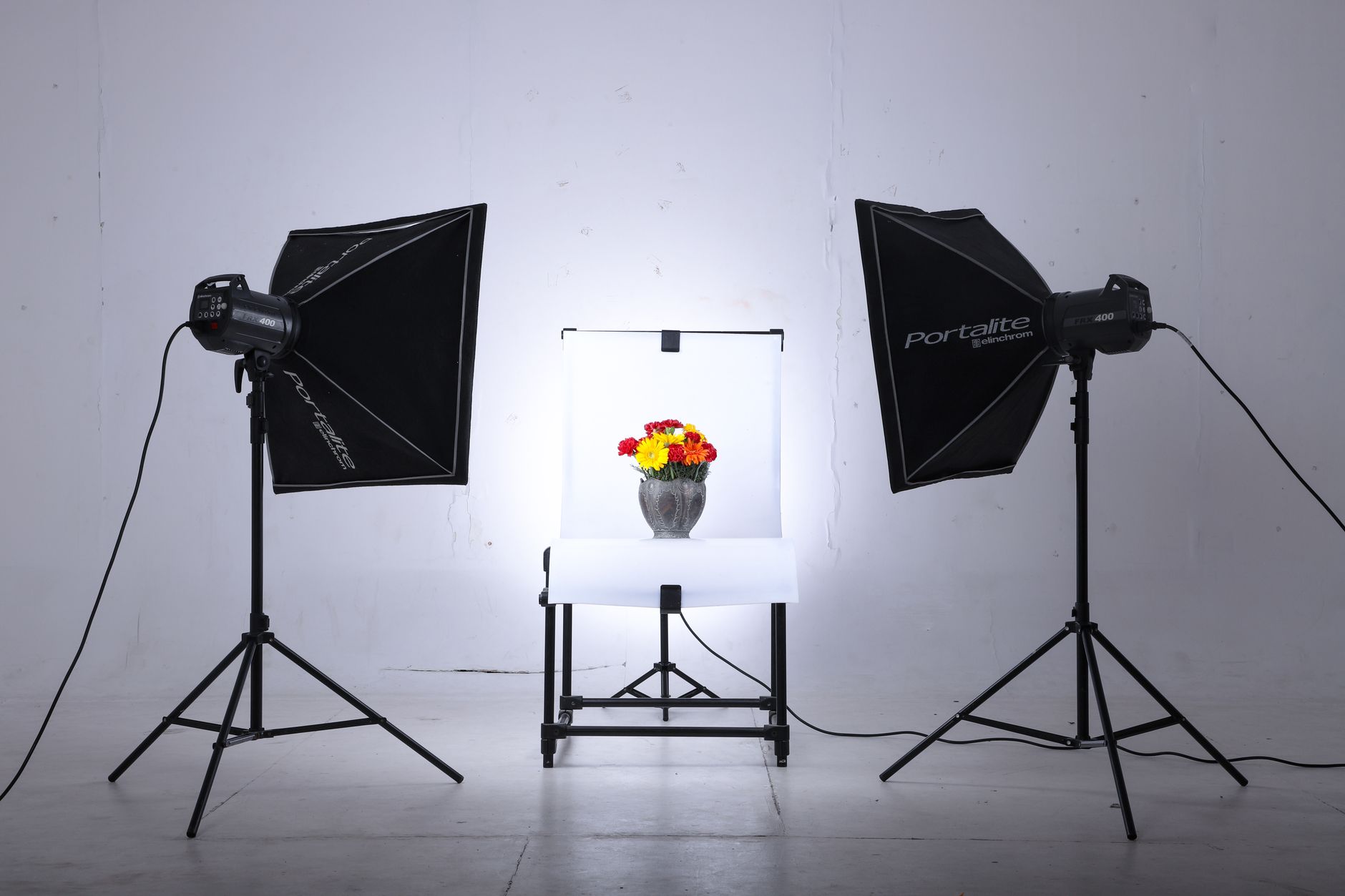
Most budget kits come as pairs because a second box makes a fill light: it sits on the opposite side at lower power and softens the shadows the key leaves. Two boxes also suit tabletop product shots, one on each side of the item, often lighting a seamless backdrop sweep behind and under it. A third light, often a strip or a small LED behind the subject, adds separation from the background, but it is a later step rather than a starting need.
Softbox, umbrella or LED panel: which job is it for?
A softbox is one of three common ways to get soft light at home:
- Shoot-through or reflective umbrella. Cheaper and faster to set up, and very soft, but the light spills everywhere. That is fine in a white room and a problem when you want a darker background.
- Softbox. Nearly as soft as an umbrella of the same size, with far more control over where the light goes, especially with a grid fitted.
- Flat LED panel. Compact and easy to mount on a desk or camera, but small and therefore harder unless it has its own diffuser. Panels suit fill, background and on-the-move filming more than a soft key light.
For a fixed desk or a corner of a room used for filming, a softbox usually gives the best balance of softness and control. For filming away from home, a small panel is often more practical, as the portable lighting kit guide explains.
Common softbox mistakes
- Too far away. A box across the room acts like a small source: harder and dimmer. Bring it in until it sits just outside the frame.
- Straight on. A box directly behind the camera flattens a face. Angling it 30 to 45 degrees to one side gives shape.
- Diffuser left off. Without the front panel the bulb shows as a hotspot and the light hardens. Fit both layers if the box has them.
- Mixed colours. A daylight softbox next to a warm room lamp leaves one side of the face orange. Turn the room light off or match the colour temperature.
- Heat and fabric. Modern LED bulbs run cool, but an old high-wattage bulb inside a fabric box can get hot. Use the bulbs the kit specifies.
Summary: how to read any softbox listing
- Check the kind of kit. Screw-in bulb kit, or a Bowens-mount box that needs a separate light.
- Match the size to the subject. Larger and closer gives softer light.
- Compare real watts or lux, never the "equivalent" figure.
- Look for CRI 95 or higher, and decide whether bi-colour is worth having in your room.
- Check stand height and footprint, and whether a boom arm is needed for overhead shots.
- Start with one light, and add the second as fill when the first is placed well.
Frequently asked questions
What is a softbox used for?
Is a softbox better than a ring light?
What size softbox do I need for YouTube?
Can a softbox use any light bulb?
Do I need one softbox or two?
Sources
One Light Setup for YouTube
Colour Temperature and CRI
Budget Lighting for Product Videos